


VR Based Occupational Health and Safety Training Applications

VR WORK SAFETY TRAINING SIMULATIONS:
- Working at heights with horizontal and vertical lifeline training
- Risk finding training
- Fire safety training
- Personal protective equipment selection training
- Lifting safety training
- LOTO training
- Confined space and gas safety
REDUCE WORKPLACE ACCIDENTS WITH VIRTUAL REALITY
The user can walk in the simulation and in the actual world at the same time, and the user's mistakes in the simulation have consequences in the virtual world. For instance, if a worker in a high-rise building fails to take the appropriate measures, the user falls from the building during the simulation, an explosion occurs as a result of welding by a welder in an area with explosive gas, and so on, the results can be reproduced.
VARIOUS VIRTUAL ACCIDENTS SCENARIOS
It is possible to interact with virtual objects using the controller. (Hands and virtual objects can communicate with one other.) The Unity Physics Engine is used to create user-interactive simulations. Objects and models developed are compatible using virtual reality. In the simulation, there are virtual workers executing their jobs and virtual construction equipment with user interaction.
MINIMIZE RISKS WITH VIRTUAL REALITY
The simulation's objects are of such high quality and realism that they do not detract from the user's perception of realism. The user can walk around the simulation in any direction and look 360 degrees in any direction. The user can identify and mark objects that pose danger in virtual environment.
EVALUATE CANDIDATES
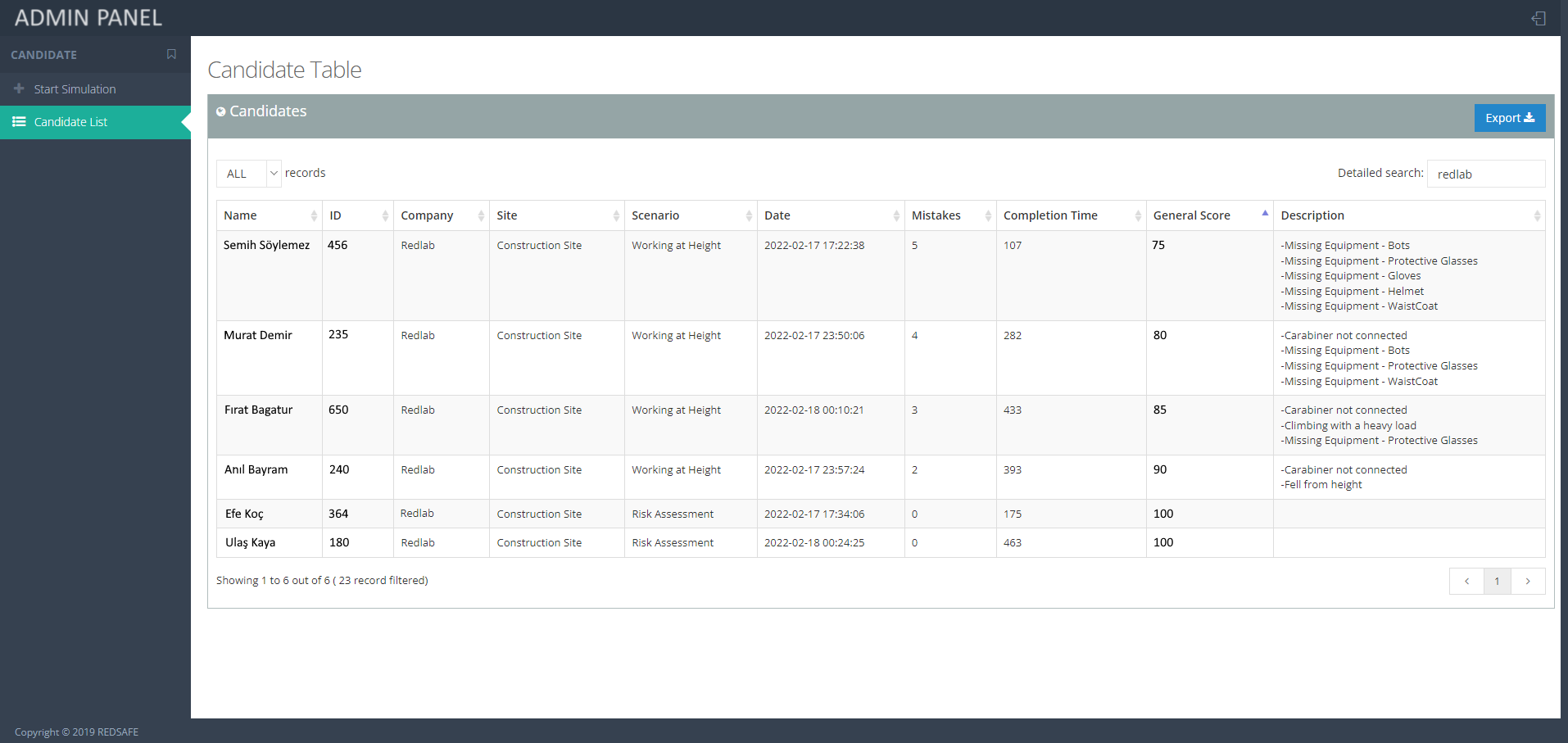
The user's hand motions, interaction with objects (holding the object, putting it on the ground, etc.), if they turn their head to the required places to focus, whether they successfully utilize the equipment they need to use, and etc are all recorded in real time in the database.